 +91 - 8010-555-111
 INR
INR  AUD - Australian Dollar
  BHD - Bahraini Dinar
  GBP - British Pound
  CAD - Canadian Dollar
  EUR - Euro
  HKD - Hong Kong Dollar
  IDR - Indonesian Rupiah
  ILS - Israeli New Shekel
  JPY - Japanese Yen
  KWD - Kuwaiti Dinar
  MYR - Malaysian Ringgit
  MUR - Mauritian Rupee
  NZD - New Zealand Dollar
  OMR - Omani Rial
  PHP - Philippine Peso
  QAR - Qatari Riyal
  SAR - Saudi Riyal
  SGD - Singapore Dollar
  CHF - Swiss Franc
  USD - US Dollar
  AED - United Arab Emirates Dirham
  VND - Vietnamese Dong






























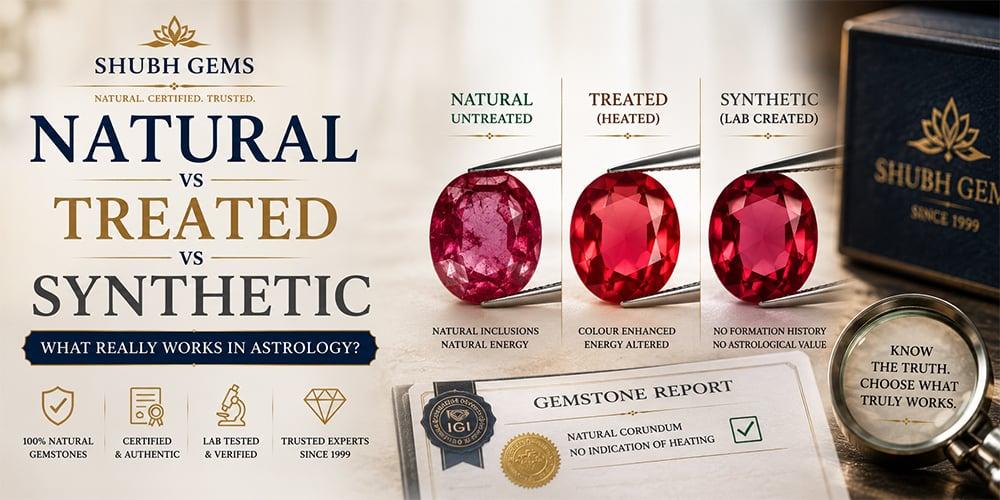
Here is a question we hear from customers every week at Shubh Gems: “The stone I bought looks exactly the same as yours. The colour is beautiful, it has a certificate, and it cost half the price. What is the difference?”
The difference is almost always this: the less expensive stone has been treated — heated, filled, diffused, or otherwise artificially enhanced. It may look identical, even better. The certificate may even mention it — buried in the Comments section in technical language most buyers never check. But for astrological purposes, that stone is completely ineffective. It is a beautiful piece of coloured mineral with no planetary energy to transmit.
This guide explains exactly why — in plain language. What makes a gemstone natural, what treatments do to its internal structure, why synthetic gemstones deliver no astrological benefit, and how to protect yourself from paying for something that simply does not work for the purpose you are buying it.
The Fundamental Principle — Why Natural Gemstones Work for Astrology
Vedic gemstone therapy — ratnavidya — is based on a principle that has been documented in classical Indian texts for thousands of years: natural gemstones are formed deep within the earth over millions of years under specific combinations of heat, pressure, chemical composition, and cosmic influence. During this formation process, they develop a crystalline structure that is uniquely aligned with the energy of specific planets.
A natural Ruby formed over millions of years in Myanmar or Mozambique carries the vibrational signature of that entire formation history. This natural cosmic energy — undisturbed by human intervention — is what makes astrological gemstones effective.
When a gemstone is treated — heated, filled, irradiated, or otherwise altered — that natural formation history is disrupted. The crystalline structure is changed. The stone may look more beautiful, but its vibrational signature — its ability to transmit planetary energy — is permanently compromised. When a gemstone is grown in a laboratory, it has no formation history at all. It is chemically identical to natural but energetically empty.
This is the foundational reason why natural, unheated, untreated gemstones are non-negotiable for astrological use. Everything else follows from this.
What Is a Natural Gemstone?
A natural gemstone is one that was formed entirely by geological processes within the earth — without any human intervention in its creation or in its appearance after mining. Natural gemstones:
- Were formed over millions of years through natural geological processes — heat, pressure, chemical crystallisation — deep within the earth or in mineral-rich water environments
- Were mined from the earth in their natural state
- May have been cut and polished — cutting and polishing are mechanical processes that shape the stone without altering its chemical or crystal structure, and are always acceptable
- Have not been subjected to any chemical, thermal, or radiation treatment to alter or improve their colour, clarity, or appearance
A natural gemstone carries its complete formation history — intact, undisturbed, and astrologically potent. The inclusions you see inside a natural gemstone are part of this history — proof of natural formation and, in Vedic gemology, indicators of the stone's authenticity and natural energy.
At Shubh Gems, every gemstone we sell is 100% natural — formed by nature, mined from the earth, and never subjected to any treatment. Our stones are certified by IIGJ, IGI, GIA, GJI, or GII confirming natural origin and no treatment. This is our foundational, non-negotiable standard.
What Is a Treated Gemstone — The Most Critical Issue for Indian Buyers
Gemstone treatment refers to any process applied to a gemstone after mining to artificially improve its colour, clarity, lustre, or overall appearance. Treatments make low-quality, unattractive rough material look like high-quality gemstones — and allow sellers to charge premium prices for material that has no astrological value.
The scale of the treatment problem in the Indian gemstone market is significant. For certain gemstones — particularly Ruby, Blue Sapphire, and Yellow Sapphire — the vast majority of stones sold are treated in some form. Understanding the most common treatments is essential for every astrological gemstone buyer.
Heat Treatment — The Most Widespread Treatment
Heat treatment involves exposing a gemstone to extremely high temperatures — often between 1,000 and 1,800 degrees Celsius — to dissolve inclusions, improve colour, and enhance clarity. The process is widely used across the global gemstone industry, particularly for corundum gemstones (Ruby, Sapphire) and many others.
What heat treatment does to a gemstone astrologically: the extreme temperature permanently disrupts and realigns the stone's internal crystal lattice — the precise molecular arrangement that gives the natural stone its vibrational signature. The stone that emerges from the heating furnace may be visually more attractive, but it is fundamentally a different material from what entered it. Its natural formation history — and with it, its ability to transmit planetary energy — is permanently destroyed.
A heat-treated Ruby is not a natural Manik for astrological purposes. A heat-treated Blue Sapphire is not a natural Neelam. Regardless of how beautiful they look, how much they cost, or what the certificate says about their origin — if the certificate discloses heat treatment, the stone has zero astrological value.
- Estimated percentage of Ruby sold in India that is heat-treated: over 90%
- Estimated percentage of Blue Sapphire sold globally that is heat-treated: over 90%
- Estimated percentage of Yellow Sapphire that is heat-treated in the Thai/Bangkok market: very high
- Certificate disclosure: “Indications of heating”, “Heat treatment applied”, or “Thermally treated” — any of these mean the stone is heat-treated
Glass Filling and Fracture Filling — The Most Deceptive Treatment
Glass filling — also called lead glass filling or fracture filling — involves impregnating heavily fractured, low-quality gemstone material with molten glass, resin, or polymer. The filler material fills the fractures and voids, making the stone appear dramatically cleaner and more transparent than it actually is.
Glass-filled stones are structurally composite materials — part gemstone, part glass or resin. They are astrologically worthless, structurally fragile, sensitive to heat and chemicals, and fundamentally misrepresented when sold as natural gemstones. Glass-filled Ruby is particularly prevalent in the Indian market — sometimes sold at attractive prices to buyers who do not know to check the certificate.
- Certificate disclosure: “Glass filling”, “Lead glass filling”, “Fracture filling”, “Clarity enhancement” — any of these disqualify the stone for astrological use
- Most commonly affects: Ruby, Emerald (resin/oil filling), occasionally other stones
Beryllium Diffusion and Lattice Diffusion — Hidden Colour Enhancement
Diffusion treatments involve heating gemstones in the presence of specific elements — beryllium for colour enhancement, typically in yellow and orange sapphires — which diffuse into the stone's surface or lattice and create or intensify colour artificially. The resulting colour may look natural but is an artificial surface or near-surface phenomenon, not the stone's own natural colour.
Beryllium-diffused sapphires are a significant concern in the yellow and orange sapphire market. The treatment is difficult to detect without specialised laboratory equipment and may not always be disclosed by less reputable sellers. A certificate from a recognised laboratory will disclose beryllium treatment when detected.
- Certificate disclosure: “Beryllium diffusion”, “Lattice diffusion”, “Surface diffusion”, “Be diffusion” — any of these disqualify the stone
Oiling — The Emerald Exception
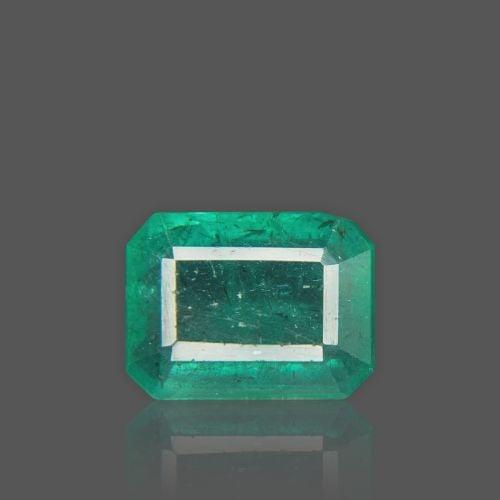
Oiling is the most common treatment for Emeralds, and it occupies a unique position among gemstone treatments. Natural Emerald almost always contains fractures (the jardin) reaching the surface — a completely normal characteristic of natural Emerald. Filling these surface fractures with natural cedar oil has been practiced for centuries and is widely accepted in the gemstone trade at the minor (F1) level.
The key distinction for astrological use: minor natural oil filling at F1 level — disclosed on the certificate — is generally accepted for astrological purposes because it does not significantly alter the stone's crystal structure. Heavy oiling (F2), significant oiling (F3), or synthetic resin/polymer filling does alter the stone more substantially and is not recommended for serious astrological use.
- F1 (Minor/Insignificant): Accepted for astrological use in Emerald
- F2 (Moderate): Requires caution — discuss with your Astro Vedic Expert
- F3 (Significant/Heavy): Not recommended for astrological use
- Resin or polymer filling: Not acceptable for astrological use regardless of extent
Shubh Gems deals exclusively in natural, unheated, untreated gemstones — our foundational standard for 25 years. Our professional Gemstone Consultants help you understand exactly what you are buying and how to verify it through your certificate. Connect at shubhgems.com/astro-advice or call +91-8010-555-111.
What Is a Synthetic Gemstone — Why It Delivers Zero Astrological Benefit
A synthetic gemstone — also called a lab-created or lab-grown gemstone — is one that is chemically, physically, and optically identical to its natural counterpart but was created in a laboratory rather than formed by geological processes in the earth.
Modern gemological laboratories can grow Ruby, Sapphire, Emerald, and many other gemstones with extraordinary precision. The chemical formula is identical. The hardness is identical. Even the crystal structure is essentially the same. Under a standard jeweller's loupe, a synthetic sapphire and a natural sapphire look identical. Without advanced laboratory testing, the difference is invisible to the human eye.
But for astrological purposes, the difference is absolute.
A synthetic gemstone has no formation history. It was not formed over millions of years through geological processes. It was not subject to the cosmic influences that occur during natural mineral formation deep within the earth. It carries no planetary energy — it is energetically empty, regardless of how chemically perfect it is. Wearing a synthetic gemstone for astrological purposes is wearing a beautiful, expensive piece of coloured glass. Nothing more.
Synthetic gemstones are not fraudulent when sold honestly as synthetic — they are used legitimately in jewellery, fashion, and industrial applications. The fraud occurs when they are sold as natural gemstones for astrological purposes — at natural gemstone prices, without disclosure.
- Common synthetic gemstones in the Indian market: Synthetic Ruby (Verneuil process), Synthetic Sapphire, Synthetic Emerald (Chatham, Gilson), Synthetic Spinel
- Certificate disclosure: A genuine laboratory certificate will always state 'Natural' or 'Synthetic' in the Species or Comments field. Any certificate stating 'Synthetic', 'Laboratory-created', 'Lab-grown', or 'Flux-grown' means the stone has no astrological value
Natural Gemstone vs Simulant — An Important Additional Distinction
Beyond treated and synthetic, a third category is worth understanding — simulants. A simulant is a completely different material that resembles a gemstone visually but is not the same mineral at all.
- Citrine sold as Yellow Sapphire (Pukhraj) — Citrine is a quartz variety. Yellow Sapphire is corundum. Chemically, mineralogically, and astrologically completely different.
- Blue Topaz sold as Blue Sapphire (Neelam) — Blue Topaz and Blue Sapphire are entirely different minerals with completely different planetary associations and astrological properties.
- Red Glass sold as Ruby (Manik) — Coloured glass has no mineral identity and no astrological value.
- Quartz Cat's Eye sold as Chrysoberyl Cat's Eye (Lehsunia) — These are completely different minerals with different astrological applications.
Simulants are the most straightforward form of fraud — selling one material as another. A certificate from a recognised laboratory will always identify the correct species, protecting buyers from this category of misrepresentation.
How to Identify Whether Your Gemstone Is Natural and Untreated
The only reliable method for confirming a gemstone's natural origin and treatment status is a certificate from a recognised gemological laboratory — IIGJ, IGI, GIA, GJI, or GII. Laboratory testing uses advanced scientific equipment — spectroscopy, X-ray fluorescence, UV fluorescence, microscopy — that can detect treatments invisible to the naked eye or even a standard loupe.
When evaluating any certificate, check these fields:
- Species and Variety: Must correctly identify the gemstone (e.g. Corundum / Yellow Sapphire)
- Treatment or Comments: Must state 'No indications of heating', 'Unheated', 'No treatment', or for Emerald, the oiling grade (F1 acceptable, F2-F3 requires caution)
- Natural or Synthetic: Must confirm 'Natural' — any mention of Synthetic, Lab-created, or Lab-grown means the stone has no astrological value
- Report Number: Must be verifiable on the issuing laboratory's official website
We strongly advise against home testing methods for any gemstone — they are unreliable, unscientific, and can damage the stone. Only a reputed gemological laboratory can reliably determine whether a gemstone is natural, treated, or synthetic. If you wish to verify any stone you own — from any source — visit any branch of IIGJ, IGI, GIA, GJI, or GII for independent testing.
The Price Reality — Why Natural Untreated Gemstones Cost More
One of the most consistent markers of a treated or synthetic gemstone is price. Natural, unheated, untreated gemstones of good quality command real market prices that reflect their genuine rarity. When a seller offers stones at prices far below the established market rate for natural quality, the explanation is almost always treatment, synthesis, or misrepresentation.
Here is why natural, unheated quality costs what it does:
- Genuine rarity: Natural, unheated Ruby of good colour represents a small fraction of Ruby mined worldwide. Most mined Ruby is low quality and would be commercially unviable without treatment.
- Selective sourcing: Sourcing natural, unheated stones requires direct mine relationships, expert gemological knowledge, and significant rejection of treated material — all of which carry real costs.
- Laboratory certification: Proper certification from IIGJ, IGI, GIA, GJI, or GII costs money and time — and the commitment to certify every stone reflects a seller's commitment to transparency.
At Shubh Gems, our prices reflect the genuine cost of sourcing, certifying, and standing behind natural, unheated, untreated gemstones. Genuine natural quality has a genuine cost — stones priced far below established market rates are almost certainly treated, synthetic, or misrepresented.
Gemstone Treatment by Stone — A Quick Reference
Here is a summary of treatment concerns for each major astrological gemstone:
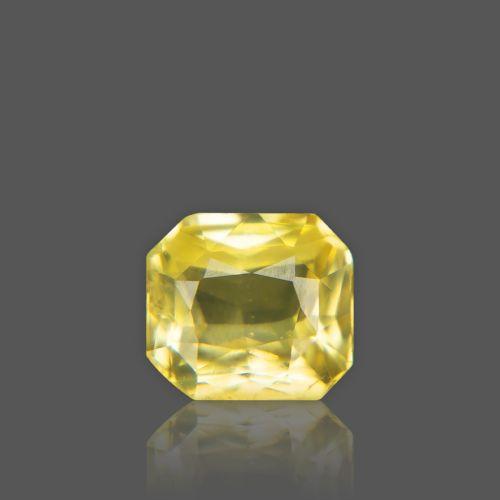
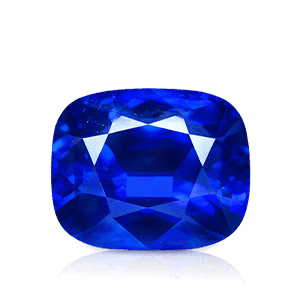
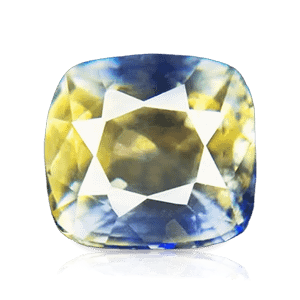
- Yellow Sapphire (Jupiter Ratna): Heat treatment and beryllium diffusion are primary concerns. Unheated Ceylon quality is the standard for astrological use.
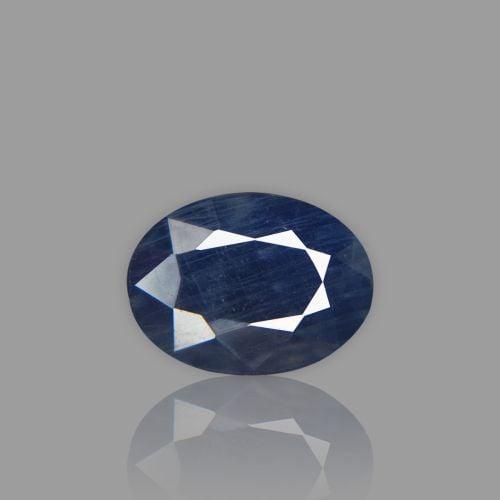
- Blue Sapphire (Saturn Ratna): Heat treatment and glass filling are widespread. Over 90% of market supply is treated. Unheated Ceylon quality essential for astrological use.
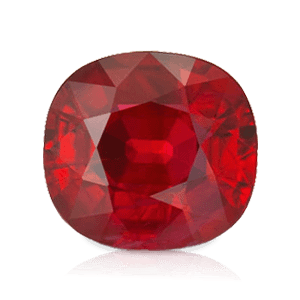
- Ruby (Surya Ratna): Heat treatment and glass filling are the most critical issues. Over 90% of market supply is treated. Natural unheated from Burma, Mozambique, or Africa required.
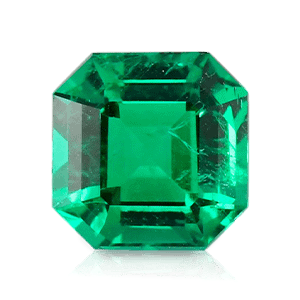
- Emerald (Budh Ratna): Oiling (F1 acceptable), resin filling (not acceptable), and fracture filling are primary concerns. Natural from Zambia, Colombia, or Brazil with treatment clearly disclosed.
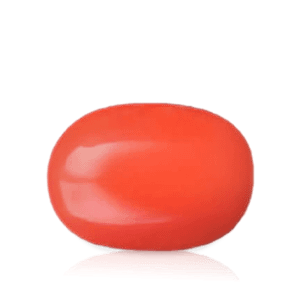
- Red Coral (Mangal Ratna): Dyeing and reconstitution are primary concerns. Natural Italian or Japanese sea coral with laboratory confirmation required.
- Pearl (Chandra Ratna): Coating and low-nacre freshwater cultivation are primary concerns. South Sea, Keshi, Basra, or Venezuela natural and cultured sea pearl recommended.
- Opal (Shukra Ratna): Doublets, triplets, and Ethiopian opal (low durability) are primary concerns. Solid natural Australian Opal required.
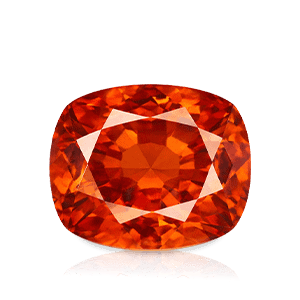
- Hessonite (Rahu Ratna): No significant treatment concerns — its relatively accessible price makes treatment commercially unviable.
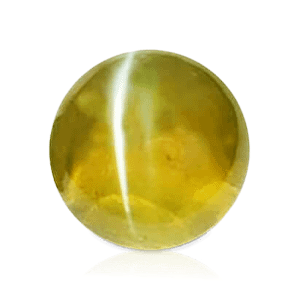
- Cat's Eye / Chrysoberyl (Ketu Ratna): No significant treatment concerns — the primary issue is misrepresentation of Quartz Cat's Eye as Chrysoberyl Cat's Eye.
Every gemstone at Shubh Gems comes with a certificate from IIGJ, IGI, GIA, GJI, or GII confirming natural origin and no treatment. Our Gemstone Consultants explain exactly what your certificate means and help you verify it independently. Speak with our team at shubhgems.com/astro-advice or +91-8010-555-111.
Why Shubh Gems' Standard Matters
In a market where the majority of astrological gemstones sold are treated, synthetic, or misrepresented, Shubh Gems' 25-year commitment to natural, unheated, untreated gemstones is not a marketing claim — it is the foundation of everything we do.
- We source directly from mine origins — Ceylon, Burma, Mozambique, Zambia, Colombia, Italy, Japan, Australia — with direct relationships that give us full traceability
- We certify every stone with IIGJ, IGI, GIA, GJI, or GII — independent laboratories whose certificates are verifiable online
- Fresh gemstones only — never previously owned, never recirculated
- Independent verification always welcome — full refund if authenticity is ever in question
Our Astro Vedic Experts ensure the right gemstone for your Kundali. Our Gemstone Consultants ensure the stone you purchase is genuine, certified, and within your budget.
Connect with Shubh Gems' Astro Vedic Experts for a free birth chart consultation and gemstone recommendation. Our Gemstone Consultants help you find the right certified natural stone within your budget. Visit shubhgems.com/astro-advice or call +91-8010-555-111.
Frequently Asked Questions
If a treated gemstone looks the same as a natural one, why does treatment matter for astrology?
Because astrological gemstones work through their natural crystalline energy — not their visual appearance. The planetary energy that a natural, unheated gemstone transmits is a product of its millions of years of natural formation. Treatment permanently disrupts this natural formation signature. A heat-treated Ruby and a natural Ruby look similar, but one carries the Sun's energy and one does not. The visual appearance is irrelevant to astrological function.
I was told my gemstone is 'natural' but it has been heat-treated. Is it still natural?
This is a common source of confusion. A heat-treated gemstone is natural in the sense that it originated as a natural mineral mined from the earth. However, for astrological purposes, 'natural' must mean natural and untreated — because treatment permanently alters the stone's crystal structure and destroys its astrological energy. When we at Shubh Gems say natural, we always mean natural and untreated. The certificate must confirm both.
Can a synthetic gemstone work for astrology if it is chemically identical to natural?
No. Chemical identity is not the same as astrological equivalence. A synthetic gemstone has no geological formation history — it was not formed over millions of years by the same cosmic processes that make natural gemstones energetically aligned with planetary frequencies. It is chemically similar but energetically empty. Wearing a synthetic sapphire for Saturn is equivalent to wearing blue-coloured glass — visually similar but astrologically inert.
My certificate says 'minor oiling' for my Emerald. Is it still suitable for astrological use?
Minor oiling at F1 level is generally accepted for astrological use in Emerald and does not significantly compromise the stone's natural energy. The F1 designation means the oiling is insignificant or minor — a traditional practice that has been part of Emerald gemology for centuries. F2 or F3 oiling, or synthetic resin filling, is a different matter and is not recommended for serious astrological use.
How do I know if the gemstone I already own is treated?
The only reliable way is to have it tested by a recognised gemological laboratory — IIGJ, IGI, GIA, GJI, or GII. If it came with a certificate, check the Treatment or Comments field carefully. If no certificate exists, take the stone to the nearest branch of any recognised laboratory for testing. We strongly advise against home testing methods — they are unreliable and can damage the stone.
Are treated gemstones completely worthless?
For astrological use, yes — a treated gemstone delivers no planetary energy regardless of its visual quality, carat weight, or price. For non-astrological purposes — jewellery, fashion, ornamental use — treated gemstones are perfectly valid and are used widely and legitimately across the jewellery industry. The issue is specifically when treated stones are sold at natural stone prices for astrological purposes without disclosure.
The difference between a natural, unheated gemstone and a treated one is invisible to the eye — but it is everything for astrological use. One transmits planetary energy. One does not. One works. One is a beautiful, expensive ornament.
At Shubh Gems, we have maintained one standard for 25 years: natural, unheated, untreated, certified. Not because it is easy — finding genuine natural quality requires significantly more effort, expertise, and selectivity than buying treated stock. But because it is the only standard that actually delivers what astrological gemstone buyers are paying for and deserve.




Thoughts