 +91 - 8010-555-111
 INR
INR  AUD - Australian Dollar
  BHD - Bahraini Dinar
  GBP - British Pound
  CAD - Canadian Dollar
  EUR - Euro
  HKD - Hong Kong Dollar
  IDR - Indonesian Rupiah
  ILS - Israeli New Shekel
  JPY - Japanese Yen
  KWD - Kuwaiti Dinar
  MYR - Malaysian Ringgit
  MUR - Mauritian Rupee
  NZD - New Zealand Dollar
  OMR - Omani Rial
  PHP - Philippine Peso
  QAR - Qatari Riyal
  SAR - Saudi Riyal
  SGD - Singapore Dollar
  CHF - Swiss Franc
  USD - US Dollar
  AED - United Arab Emirates Dirham
  VND - Vietnamese Dong































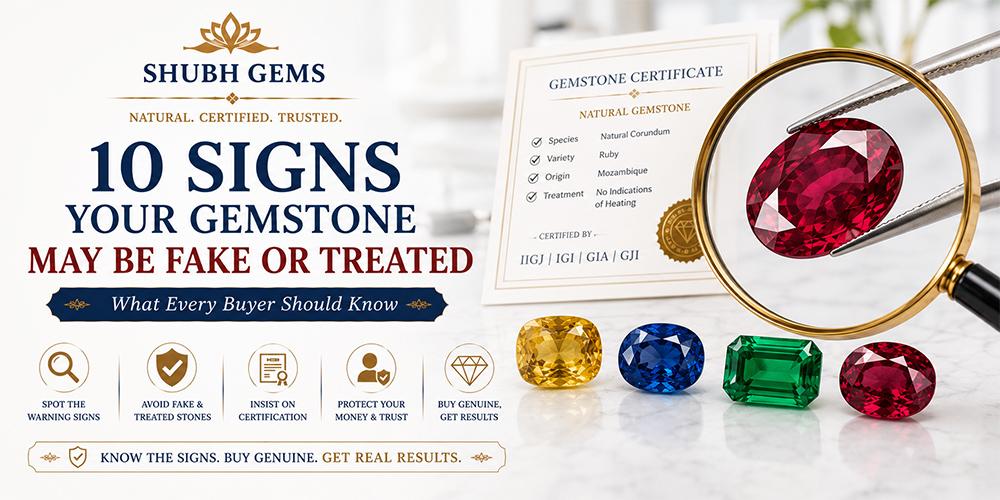
In 25 years of specialising in astrological gemstones, we have seen the same story repeated thousands of times. A buyer purchases what they believe is a natural, genuine gemstone — sometimes at a seemingly good price, sometimes even at a premium. Months pass. The stone delivers no results. They come to us, certificate in hand, and we identify the problem within minutes: the stone is heat-treated, glass-filled, synthetic, or not even the right mineral.
The frustrating reality is that most of these situations were avoidable. Not because the signs were invisible — but because the buyer did not know what to look for. This guide gives you exactly that: ten clear, practical signs that a gemstone may not be what it claims to be. These are signals from 25 years of handling tens of thousands of stones and hearing the experiences of customers who were misled.
One important principle before we begin: no single sign below is conclusive on its own. The only definitive verification is a certificate from a recognised gemological laboratory — IIGJ, IGI, GIA, GJI, or GII. These signs are your pre-purchase warning system — a reason to slow down, ask harder questions, and insist on proper certification before committing.
The 10 Signs — What to Watch For
Sign 1: The Stone Is Completely Flawless — Internally Clean With No Natural Inclusions
This is one of the most reliable and widely observed signs that a gemstone may not be naturally formed. Natural gemstones are created over millions of years under intense geological conditions — heat, pressure, chemical reactions, and shifting environments. This formation history almost always leaves traces inside the stone: tiny crystal inclusions, fine silk needles, feather-like fractures, fingerprint patterns. These are not defects — they are proof of natural origin. They are the geological fingerprint of a genuinely earth-formed stone.
When a gemstone claiming to be natural appears completely clean to the eye with no inclusions whatsoever — especially at a moderate price — this is a significant warning signal. It suggests the stone may be synthetic (lab-grown, with no formation history and therefore fewer inclusions), glass-filled (fractures have been filled to create the appearance of clarity), or simply not what it claims to be.
A small but important caveat: some synthetic manufacturers have begun deliberately adding artificial inclusions to their stones to mimic natural formation patterns. This makes the completely-clean test less reliable than it once was — which is precisely why laboratory certification has become more important than ever. The eye alone is no longer sufficient.
Natural gemstones contain inclusions. A completely flawless stone at a moderate price is more likely synthetic or treated than a rare natural specimen. Rare eye-clean natural stones do exist — but they are priced accordingly, not as bargains.
Sign 2: The Colour Is Too Vivid, Too Deep, or Unnaturally Uniform
Natural gemstones have colour that is organic, varied, and characteristic of their specific mineral formation. A natural Yellow Sapphire has a golden warmth that is slightly uneven in distribution. A natural Ruby has red with subtle secondary tones that shift in different lights. A natural Emerald has a green that is rich but not uniform throughout the stone. This natural variation in colour — what gemologists call colour zoning — is characteristic of genuine earth-formed minerals.
When a gemstone's colour appears unnaturally perfect — too vivid, too uniformly distributed, too saturated without any variation — it is a sign worth investigating. Treated stones are often enhanced specifically to achieve a colour perfection that nature rarely produces. Dyed stones frequently show overly uniform, almost painted-on colour. Glass-filled stones can appear artificially bright. Heat treatment intensifies and homogenises colour in ways that the natural crystal structure would not produce on its own.
The buyer's instinct of "this colour seems too perfect" is worth trusting. Not every vivid stone is treated — but vividness combined with low price and a too-clean appearance is a combination that rarely reflects genuine natural quality.
Sign 3: Something Feels Too Good to Be True
This sign sounds subjective — but experienced buyers develop a reliable instinct for it, and it is worth naming directly. When a seller presents a stone as high-quality natural with an excellent origin, vivid colour, good clarity, and a recognisable certificate — at a price that seems significantly below what such quality would genuinely cost — something is wrong.
Natural, unheated gemstones of genuine quality are rare. Their rarity is reflected in their price. The economics of sourcing, selecting, certifying, and standing behind a genuine natural stone do not support below-market pricing dramatically. A natural unheated Ceylon Blue Sapphire of good quality cannot be sold at a small fraction of established specialist prices and remain genuine. Either the quality is misrepresented, the treatment status is not disclosed, or the stone is not what it claims to be.
Trust your instinct when something feels too good to be true in gemstone buying. It almost always is.
Sign 4: The Price Is Dramatically Below Market Rate for the Claimed Quality
Building on Sign 3 — this is the same principle made concrete. Genuine natural, unheated astrological gemstones have real market prices that reflect their rarity. When a seller claims a stone is natural and unheated but prices it far below what established specialist dealers charge for comparable quality, the price gap itself is the warning.
This does not mean every expensive stone is genuine — but it does mean every dramatically cheap "natural unheated" stone warrants very close scrutiny of the certificate and treatment disclosure. Price is not a guarantee of quality. But a price that is incompatible with genuine natural rarity is almost always a signal that the quality claim is not what it appears to be.
Sign 5: The Certificate Does Not Match the Actual Stone
This is one of the most serious and direct signs of a problem — and one that buyers miss because they do not know to check. A laboratory certificate describes a specific stone: its species, variety, weight, measurements, colour, and most importantly, its treatment status. Every detail on the certificate should correspond exactly to the stone in your hand. Check these specifically:
- Carat weight: The weight on the certificate should match the stone. Even a small discrepancy suggests the certificate may belong to a different stone.
- Measurements: The millimetre dimensions stated on the certificate should correspond to the stone's actual size.
- Stone photograph: Most certificates include a photograph of the actual stone. Compare the shape, colour, and visible characteristics carefully with the stone you are holding.
- Treatment field: This is the most critical field. It must clearly state the treatment status. If the certificate says "No indications of heating" but the seller describes the stone's treatment differently — there is a mismatch.
A certificate that cannot be matched to the physical stone in your possession is either a different stone's certificate being presented, or a certificate that was not issued by the laboratory it claims to be from.
Sign 6: The Treatment Field Is Vague, Missing, or Unclear
A genuine certificate from IIGJ, IGI, GIA, GJI, or GII will always address treatment status in the Comments or Treatment field. For astrological gemstone buyers, this field must clearly state one of the following for Ruby, Blue Sapphire, and Yellow Sapphire: "No indications of heating", "Unheated", or "No treatment".
When this field is blank, vague ("no comment"), uses unclear language, or is absent from the document — this is a serious warning sign. A reputable laboratory will always address treatment. Absence of disclosure in this field does not mean absence of treatment — it means the certification is incomplete, the laboratory may not be recognised, or the document may not be genuine.
If a seller shows you a certificate where the treatment field is missing or vague and assures you verbally that the stone is natural and untreated — verbal assurance is not certification. Insist on a clear, specific, written treatment disclosure from a recognised laboratory.
Sign 7: The Source Is Not Trusted, Verified, or Established
The seller is as important as the stone. A genuine, reputable astrological gemstone specialist has a verifiable physical address, a documented track record, recognisable laboratory certification on every stone, and a clear, unconditional return policy. They welcome questions about treatment, origin, and certification. They do not pressure buyers to decide quickly. When a seller lacks these characteristics — operates only through social media with no verifiable address, sources stones from unnamed channels, cannot explain what the certificate says, becomes evasive when asked about treatment status, or insists on quick decisions — these are signs that the source itself is unreliable.
A trustworthy gemstone dealer's confidence in their product is evident in their transparency. Reluctance to be transparent is itself a warning sign.
Wholesale gemstone markets — Chandni Chowk, Karol Bagh, Johari Bazaar in Jaipur — are primarily trade channels for bulk B2B buyers with gemological expertise, not appropriate retail destinations for individual astrological gemstone buyers without specialist knowledge. Buyers who have purchased from these markets without expert guidance frequently discover afterwards — through testing — that their stone was treated or misrepresented.
Sign 8: The Stone's Colour Changes or Fades Over Time
Natural gemstones are chemically stable. Their colour is a product of their mineral composition and does not change under normal wearing conditions. When a gemstone's colour fades, bleaches, or changes after a period of wearing — particularly with exposure to light, sweat, or cleaning agents — this is a sign that the colour was artificially applied or enhanced.
Dyed stones — where a cheap base mineral has been artificially coloured to resemble a more expensive gemstone — are particularly vulnerable to colour change. Dyed green quartz sold as Emerald, dyed red stones sold as Ruby, or artificially coloured glass sold as Sapphire may look convincing at purchase but betray their treatment over time. If you notice colour change in a gemstone you have been wearing, have it tested by a recognised laboratory immediately.
Sign 9: The Stone Has Unusual Internal Visual Effects — Bubbles, Swirls, or Flash
Certain visual characteristics visible under magnification are reliable indicators of treated or synthetic material:
- Gas bubbles inside the stone — a classic indicator of glass or resin filling. Natural mineral inclusions do not look like rounded bubbles.
- Swirling flow patterns or curved lines — characteristic of glass, which flows when molten and freezes with these patterns. Natural crystals grow in straight or angular patterns, not curved ones.
- Rainbow flash effect in fractures — a sign of glass filling in Ruby and other stones. When the stone is tilted under light, filled fractures can produce an iridescent flash that natural unfilled fractures do not.
- Visible glue lines or seams — signs of doublet or triplet construction, where a thin slice of natural gem is bonded to glass or synthetic material. Viewed from the side, the glue line may be visible.
You do not need professional equipment to observe these characteristics. A 10x jeweller's loupe — available at any optician or gemstone store for a few hundred rupees — allows you to examine a stone under magnification before purchase. Asking to inspect the stone under a loupe is a completely reasonable request at any reputable dealer.
Sign 10: The Seller Is Evasive, Hurried, or Discourages Independent Testing
This final sign is perhaps the most telling of all — because it is about the seller's behaviour rather than the stone itself. A seller who is fully confident in their product welcomes scrutiny. They will show you the certificate immediately. They will explain what the treatment field says. They will confirm the stone has never been previously owned. They will tell you to take your time. And they will actively encourage you to have the stone independently tested at any recognised laboratory after purchase.
A seller who hurries the transaction, discourages questions about treatment or origin, becomes defensive when asked to show the treatment field on the certificate, or resists the idea of independent testing is a seller who knows something about the stone that they do not want you to know. This behaviour is the clearest single indicator that something is wrong — regardless of how attractive the stone looks or how confident the seller's claims are.
At Shubh Gems, independent testing after purchase is not just permitted — it is actively encouraged. Our lifetime authenticity guarantee means that if any stone ever proves to be other than what its certificate states, a full refund is provided unconditionally. This confidence comes from 25 years of sourcing only what we say we sell. If you have a gemstone you are uncertain about — one you already own or are considering purchasing — Shubh Gems' qualified Gemstone Consultants are available to help you evaluate the certificate and identify any concerns. Connect at +91-8010-555-111 or shubhgems.com.
What to Do If You Spot One or More of These Signs
If you notice any of the above warning signs — whether before or after purchase — here is the correct approach:
- Do not attempt home testing methods such as scratch tests, water tests, or breath tests. These are unreliable, can damage the stone, and can give false confidence either way.
- Read the certificate carefully — examine the Treatment or Comments field word by word. Look for disclosure language you may have missed initially.
- Ask the seller directly: "What does the Treatment field on this certificate say?" and "Can I have this stone independently tested after purchase?"
- Take the stone to a recognised laboratory — IIGJ, IGI, GIA, GJI, or GII — for independent testing if you have genuine doubts. The testing fee is modest relative to what you paid for the stone.
- Contact the seller with your findings if testing reveals a discrepancy. A reputable seller will engage constructively. An unreliable one will become evasive.
Frequently Asked Questions
Is a completely flawless gemstone always fake or treated?
Not always — but it is a significant warning sign, particularly when combined with a moderate or low price. Truly eye-clean natural gemstones of astrological quality do exist — but they are exceptional, rare, and priced accordingly. When a flawless-appearing stone is offered at a price that does not reflect this rarity, it is far more likely to be synthetic, glass-filled, or otherwise treated than a genuinely rare natural specimen. The combination of visual perfection and low price is the warning — not visual perfection alone.
My gemstone's colour seems slightly faded compared to when I bought it. What does this mean?
Natural gemstones do not fade under normal wearing conditions. Colour change after purchase — particularly fading or shifting in hue — is a sign that the colour may have been artificially applied or enhanced through dyeing or surface coating. Have the stone tested at the nearest branch of IIGJ, IGI, GIA, GJI, or GII for a definitive assessment.
The seller showed me a certificate but did not mention the treatment field. Should I be concerned?
Yes — the treatment field is the single most important field on a certificate for astrological gemstone buyers. A seller who presents a certificate without specifically drawing attention to the treatment disclosure — or who becomes vague when you ask about it — is a seller worth scrutinising carefully. Read the Treatment or Comments field yourself, word by word, before making any purchase decision.
I bought a gemstone from a wholesale market, and now I am not sure about its quality. What should I do?
Take the stone and its certificate to the nearest branch of IIGJ, IGI, GIA, GJI, or GII for independent testing. If the stone did not come with a recognised laboratory certificate, independent testing is even more important. The wholesale gemstone markets in India are primarily trade channels for bulk B2B buyers with professional expertise — individual buyers who visit these markets without specialist knowledge are at significant risk of receiving treated or misrepresented stones. Testing provides a definitive answer.
Final Thoughts
Identifying a treated or misrepresented gemstone does not require a gemologist's training. It requires knowing what to look for and having the confidence to ask the right questions. These ten signs — from too-perfect appearance and suspiciously low prices to vague certificates and evasive sellers — are your practical protection framework for any astrological gemstone purchase.
At Shubh Gems, we welcome every customer's scrutiny. Our certificates are from IIGJ, IGI, GIA, GJI, and GII with complete treatment disclosure. Our stones are genuinely natural, unheated, and untreated. And our commitment to independent testing means every buyer can verify what they receive — at any time, without condition.




Thoughts