 +91 - 8010-555-111
 INR
INR  AUD - Australian Dollar
  BHD - Bahraini Dinar
  GBP - British Pound
  CAD - Canadian Dollar
  EUR - Euro
  HKD - Hong Kong Dollar
  IDR - Indonesian Rupiah
  ILS - Israeli New Shekel
  JPY - Japanese Yen
  KWD - Kuwaiti Dinar
  MYR - Malaysian Ringgit
  MUR - Mauritian Rupee
  NZD - New Zealand Dollar
  OMR - Omani Rial
  PHP - Philippine Peso
  QAR - Qatari Riyal
  SAR - Saudi Riyal
  SGD - Singapore Dollar
  CHF - Swiss Franc
  USD - US Dollar
  AED - United Arab Emirates Dirham
  VND - Vietnamese Dong










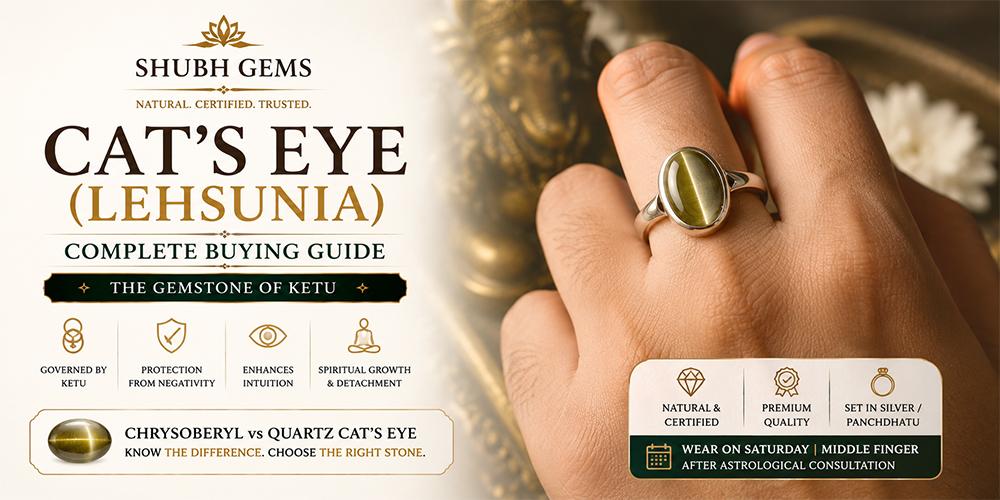
Ask most people what Cat's Eye is and they will tell you it is a gemstone. Ask a gemstone expert, and they will tell you something more precise — Cat's Eye is not the name of a gemstone. It is the name of an optical phenomenon. And understanding this single distinction can save you from one of the most common and costly mistakes in the astrological gemstone market.
This guide explains exactly what Cat's Eye means, why Chrysoberyl Cat's Eye is the only genuine choice for Ketu in Vedic astrology, how to identify quality, what Quartz Cat's Eye is and when it makes sense, and everything you need to know about wearing a genuine Lehsunia stone correctly.
What Is Cat's Eye — The Phenomenon and the Gemstone
Cat's Eye Is an Optical Phenomenon, Not a Gemstone Name
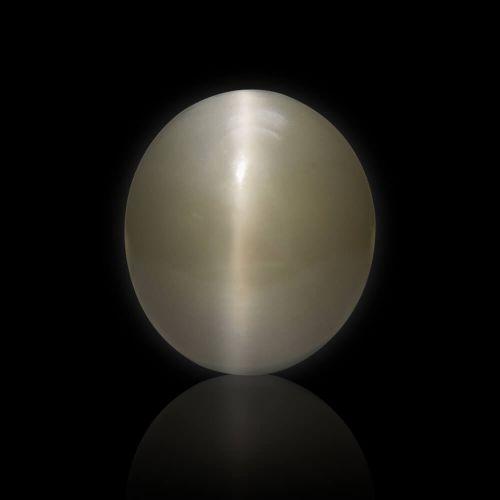
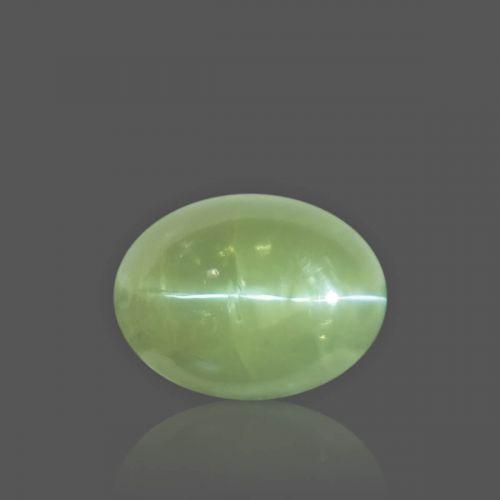
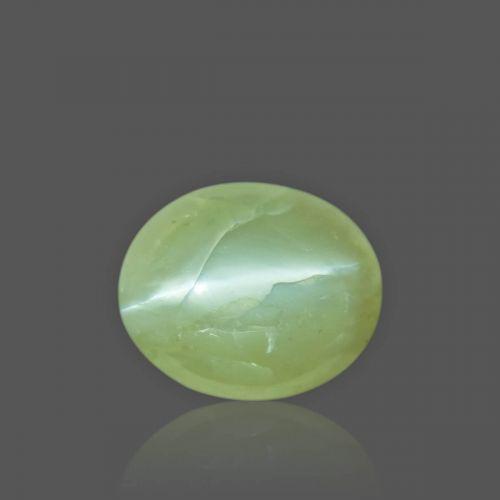
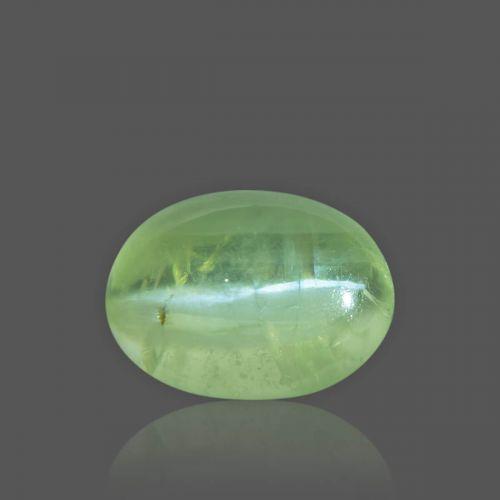
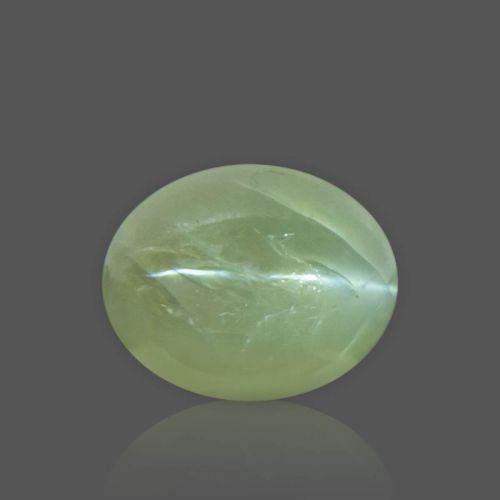
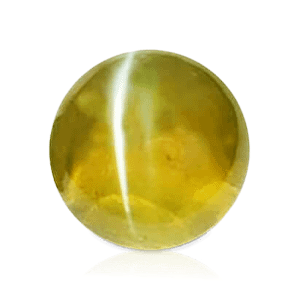
Chatoyancy — from the French word for cat's eye — is an optical effect seen in certain gemstones when they are cut as cabochons. When light hits the stone, a single bright band of reflected light appears and moves across the surface as the stone is tilted, resembling the vertical slit pupil of a cat's eye. This effect is caused by the presence of fine, parallel needle-like inclusions or fibers inside the mineral that reflect light in a single concentrated band.
The important point is that this effect can occur in several different minerals — including Chrysoberyl, Quartz, Apatite, Tourmaline, and others. So, when a seller says 'Cat's Eye' without specifying the mineral variety, the buyer has no way of knowing what they are actually purchasing. This confusion is widespread in the Indian market, leading buyers to pay Chrysoberyl prices for Quartz stones.
Chrysoberyl Cat's Eye — The Precious Variety for Ketu
Chrysoberyl Cat's Eye — known as Lehsunia or Vaidurya in Hindi and Sanskrit — is the precious variety of Cat's Eye and the only one recognised in Vedic astrology as the genuine gemstone for Ketu. Chrysoberyl is a beryllium aluminium oxide mineral, distinct from beryl (the mineral family of Emerald) despite the similar name. With a hardness of 8.5 on the Mohs scale, it is the third hardest natural gemstone after Diamond and corundum (Ruby and Blue Sapphire/Yellow Sapphire).
When gemologists, astrologers, and experienced dealers say 'Cat's Eye' in an astrological context, they mean Chrysoberyl Cat's Eye — unless specifically stated otherwise. At Shubh Gems, whenever we recommend Lehsunia for Ketu, we mean natural Chrysoberyl Cat's Eye, sourced from Ceylon or Southern India.
Quartz Cat's Eye — Affordable but Astrologically Different
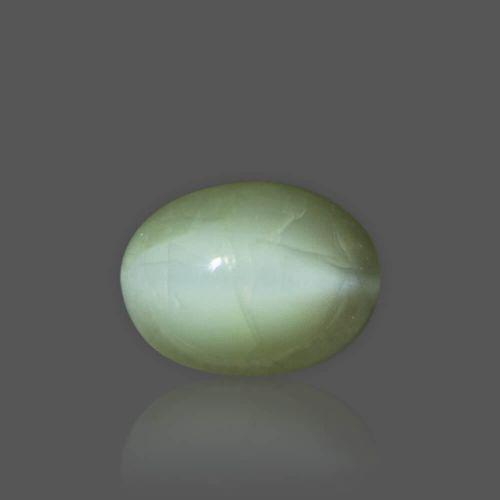
Quartz Cat's Eye is a much more common and significantly less expensive variety of the Cat's Eye phenomenon — found in the mineral quartz rather than chrysoberyl. It displays a similar chatoyant band but with less intensity, less sharpness, and a noticeably different optical quality compared to Chrysoberyl.
Quartz Cat's Eye is not the astrological gemstone for Ketu. It does not carry Chrysoberyl's planetary energy or its recognised position in Vedic gemology as the Ketu stone. However, it is widely available, reasonably priced, and serves as an accessible option for those who want to experience the energy of the Cat's Eye phenomenon at a budget-friendly price. At Shubh Gems, we stock Quartz Cat's Eye alongside Chrysoberyl Cat's Eye and are completely transparent about the difference.
Ketu in Vedic Astrology — What This Planet Governs
Ketu, like Rahu, is a shadow planet — a mathematical point in the lunar orbit rather than a physical celestial body. Together, Rahu and Ketu represent the lunar nodes. Ketu is the South Node of the Moon and is associated with spirituality, past life karma, detachment, intuition, sudden events, occult knowledge, liberation (Moksha), and protection from unseen negative influences.
A well-placed Ketu in the birth chart can bring extraordinary intuitive ability, spiritual insight, protection, and sudden unexpected gains. An afflicted Ketu can bring confusion, accidents, health challenges, and a sense of being disconnected from material reality. Ketu Mahadasha lasts 7 years and is one of the periods when wearing a genuine Chrysoberyl Cat's Eye after proper astrological consultation is most commonly recommended.
Who Should Wear Cat's Eye (Lehsunia)?
The guidance below is based on traditional Vedic astrology principles and is for general reference only. Ketu's placement, sign, and house in your specific birth chart require individual assessment. Ketu is a powerful and fast-acting planet — always consult a qualified Vedic astrologer before wearing Cat's Eye. Connect with our Astro Vedic Experts for a free personalised recommendation at shubhgems.com/astro-advice — and speak with our Gemstone Experts on +91-8010-555-111 for quality and variety guidance.
Primary Recommendation — Ketu Mahadasha and Antardasha
The most widely accepted reason for wearing Cat's Eye Chrysoberyl is during Ketu Mahadasha or Ketu Antardasha. Ketu Mahadasha lasts 7 years. Wearing a genuine Chrysoberyl Cat's Eye during this period — after proper birth chart consultation — is considered one of the most effective astrological remedies for channelling Ketu's energy productively and mitigating its challenging effects.
Lagnas Where Cat's Eye Is Generally Recommended
- Aquarius Ascendant (Kumbh Lagna) — Ketu tends to function favourably for Saturn-ruled ascendants. Generally beneficial when Ketu is well-placed.
- Capricorn Ascendant (Makar Lagna) — Another Saturn-ruled ascendant where Ketu can deliver positive results when correctly placed in the chart.
- Scorpio Ascendant (Vrishchik Lagna) — Ketu shares an affinity with Mars, which rules Scorpio. Cat's Eye can be beneficial when Ketu is well-positioned.
- Gemini and Virgo Ascendants — Mercury is friendly to Ketu. Lehsunia may be recommended after careful birth chart analysis.
- Taurus and Libra Ascendants — Venus and Ketu share a compatible relationship. Cat's Eye may be beneficial when Ketu is favourably placed.
Cat's Eye is also worn by those seeking protection from negative energies, the evil eye, and unseen influences — all areas where Ketu's protective energy is considered particularly effective in Vedic tradition. Those in spiritual practice, research, and occult fields often find Ketu's energy particularly relevant.
Chrysoberyl Cat's Eye Quality — What to Look for When Buying Lehsunia
The Chatoyancy Effect — Sharp, Centred, and Moving
The chatoyancy — the eye effect — is the defining quality factor in any Cat's Eye stone and the primary indicator of its astrological potency. A high-quality Chrysoberyl Cat's Eye should display:
- A single, sharp, well-defined band of light — not multiple bands, not a diffuse glow, but one clear, bright line that moves smoothly across the stone's surface as it is tilted
- Strong brightness and clarity of the band — a vivid, almost silver or white line of reflected light, sometimes described as the 'Milk and Honey Effect' — the bright band (milk) moving across the warm body colour of the stone (honey)
- Centred positioning — the eye should appear near the centre of the cabochon when viewed directly, indicating the stone has been correctly oriented and cut
- Fluid movement — the band should shift smoothly and dynamically as the stone is moved, not appear static or patchy
In Vedic gemology, a sharp, bright, well-centred Cat's Eye effect is considered a direct indicator of the stone's astrological strength. A diffuse, weak, or off-centre eye is considered less potent. When selecting a Chrysoberyl Cat's Eye for astrological use, the quality of the chatoyancy is the first and most important quality check.
Colour — Honey and Golden Green Are Most Prized
Chrysoberyl Cat's Eye comes in a range of warm, organic colours. The most valued for astrological use are:
- Honey brown to golden yellow — the most prized colour in Chrysoberyl Cat's Eye. Warm, luminous, and rich — this shade is directly associated with Ketu's energy in classical Vedic gemological texts. A fine honey-coloured Cat's Eye with a sharp bright band is considered the finest for astrological use.
- Apple green to golden green — another highly regarded colour. Fresh, vivid, and lively, with a warmth that makes the chatoyancy especially striking.
- Greenish brown and brownish yellow — attractive mid-range colours that are fully valid for astrological use.
As with Hessonite, the colour should be uniform throughout the stone. Well-saturated colour combined with good transparency makes the chatoyancy effect more vivid and the stone more astrologically potent.
Transparency and Lustre
A good quality Chrysoberyl Cat's Eye should have sufficient transparency for the chatoyancy to be clearly visible — the stone should not be so heavily included or opaque that the eye effect is difficult to see. High surface lustre — the stone feels smooth and reflects light cleanly — is also important. A dull, rough-surfaced, or poorly polished stone reduces both the beauty and the astrological effectiveness of the Cat's Eye.
Cat's Eye Origin — Ceylon, Southern India & Beyond
The finest Chrysoberyl Cat's Eye gemstones come from Ceylon (Sri Lanka) and Southern India — particularly from the gem-rich regions of Kerala and Tamil Nadu. These origins have been producing Cat's Eye of exceptional colour, transparency, and chatoyancy for centuries and remain the primary sources for fine quality astrological Lehsunia.
- Ceylon (Sri Lanka) - produces the finest Chrysoberyl Cat's Eye available. Sri Lankan stones are known for their exceptional honey and golden green colours, excellent transparency, and sharp, bright chatoyancy. Ceylon Cat's Eye is the standard for quality in the astrological gemstone trade.
- Southern India (Kerala, Tamil Nadu) - also a significant source of fine quality Chrysoberyl Cat's Eye. Indian Cat's Eye of good quality is fully effective for astrological use and is often more accessible in price than comparable Ceylon quality.
- Brazil and East Africa - also produce Chrysoberyl Cat's Eye, generally at more accessible prices. Quality can vary — always verify with a laboratory certificate.
At Shubh Gems, our Chrysoberyl Cat's Eye is sourced from Ceylon and Southern India — the two origins consistently recognised for the finest quality in the astrological gemstone trade.
Quartz Cat's Eye vs Chrysoberyl Cat's Eye — A Practical Comparison
This is the comparison that every buyer of Cat's Eye gemstone in India needs to understand clearly before making any purchase decision.
- Astrological use: Chrysoberyl Cat's Eye is the recognised Ketu gemstone in Vedic astrology. Quartz Cat's Eye is not the prescribed Ketu stone and does not carry the same planetary energy.
- Hardness: Chrysoberyl scores 8.5 on the Mohs scale — very durable for daily wear. Quartz scores 7 — adequate but noticeably softer.
- Chatoyancy quality: The Cat's Eye effect in Chrysoberyl is typically sharper, brighter, and more vivid than in Quartz. The optical quality of the chatoyancy is noticeably superior in fine Chrysoberyl.
- Price: Chrysoberyl Cat's Eye ranges from ₹5,000 to ₹50,000 per carat depending on quality. Quartz Cat's Eye ranges from ₹400 to ₹1,500 per carat.
- When Quartz makes sense: For those who are not wearing Cat's Eye for strict Ketu astrological purposes, or who want to experience the chatoyancy effect at a very accessible price, Quartz Cat's Eye is a valid and attractive option. It is not a substitute for Chrysoberyl in astrological therapy, but it is a genuine natural gemstone in its own right.
At Shubh Gems, we are always transparent about which variety we are selling. Any Cat's Eye we recommend for Ketu astrological use is Chrysoberyl — certified by IIGJ, IGI, GIA, GJI, or GII. If you are ever in doubt, the certificate will clearly state the mineral species.
Natural Chrysoberyl Cat's Eye Price per Carat in India
- Medium quality — ₹5,000 to ₹12,000 per carat: Natural Chrysoberyl Cat's Eye, decent colour, acceptable chatoyancy, suitable for astrological use.
- Good quality — ₹12,000 to ₹25,000 per carat: Natural Chrysoberyl, good honey or golden green colour, clear chatoyancy, good transparency. Most popular range for serious astrological buyers.
- Premium quality — ₹25,000 to ₹50,000 per carat: Fine Chrysoberyl Cat's Eye, excellent colour, sharp bright chatoyancy, good to excellent transparency. Ceylon quality.
- Top grade— ₹50,000 and above per carat: Finest Ceylon Chrysoberyl, exceptional honey colour, electric sharp chatoyancy, top laboratory certification.
Quartz Cat's Eye price ranges from ₹400 to ₹1,500 per carat — significantly more accessible, reflecting its semi-precious status and availability. If a seller is offering Chrysoberyl Cat's Eye at Quartz prices, it is almost certainly Quartz being misrepresented. Always insist on a certificate specifying the mineral species.
How to Wear Cat's Eye (Lehsunia) — Complete Vedic Guide
- Finger: Middle finger (Madhyama) of the right hand is the primary recommendation — associated with Saturn, whose energy is compatible with Ketu. Alternatively, the ring finger is recommended in specific chart conditions. Always follow your astrologer's specific guidance.
- Metal: Silver or white gold (five-metal alloy) are both recommended. Gold is also accepted by some astrologers. The ring must be set open-backed so the stone touches the skin directly.
- Day and Time: Tuesday or Thursday evening during Shukla Paksha (waxing moon phase) — or as specifically advised by your astrologer based on your chart. Cat's Eye is one of the few Navratna stones commonly worn in the evening rather than at sunrise.
- Mantra: Om Sraam Sreem Sraum Sah Ketave Namah — recite 108 times before wearing. This is the Ketu Beej Mantra.
- Energisation Ritual: Immerse the ring or pendant for 10 minutes in a mixture of raw milk, pure honey, Gangajal, pure ghee, and fresh Tulsi leaves. Remove, rinse gently with clean water, place on a grey or smoky cloth, recite the Ketu Beej Mantra 108 times, then wear. Shubh Gems performs complete Pran Pratishtha before dispatch upon customer request.
Ketu is considered one of the fastest-acting planets in terms of gemstone response — similar to Blue Sapphire and Saturn. Always consult a qualified Vedic astrologer before wearing Lehsunia. Do not wear Cat's Eye based on general recommendations or without personalised birth chart analysis. Connect with our Astro Vedic Experts for a free consultation before your purchase.
Cat's Eye as a Pendant — An Equally Effective Option
For those who prefer not to wear a ring, Chrysoberyl Cat's Eye can be worn as a pendant in silver, set so the stone touches the skin directly. A pendant is particularly practical for those whose work involves physical activity or frequent hand use. The astrological effectiveness is fully maintained as long as the stone maintains skin contact.
What to Check on the Certificate for Genuine Cat's Eye
- Species must say: Chrysoberyl — this is the critical field that distinguishes genuine Lehsunia from Quartz Cat's Eye or other varieties
- Variety must say: Cat's Eye or Chrysoberyl Cat's Eye
- No mention of treatment, heating, coating, or artificial enhancement
- Origin (if mentioned): Sri Lanka or India for finest quality
A certificate stating 'Quartz' as the species means you are looking at Quartz Cat's Eye, not Chrysoberyl. Both are natural stones but they are fundamentally different in astrological application and price. Always read the species field on your certificate before making any Cat's Eye purchase.
At Shubh Gems, we do not recommend home testing methods for any gemstone — they are unreliable, unscientific, and can damage the stone. The only reliable verification is a certificate from IIGJ, IGI, GIA, GJI, or GII. We encourage every buyer to independently verify their stone at any reputed laboratory after purchase.
Why Shubh Gems for Your Cat's Eye (Lehsunia) Purchase
- Complete transparency on variety — we clearly specify whether a stone is Chrysoberyl or Quartz Cat's Eye. No ambiguity, no misrepresentation
- Chrysoberyl Cat's Eye sourced from Ceylon and Southern India — the finest origins for quality and chatoyancy
- Both Chrysoberyl and Quartz Cat's Eye available — giving buyers a genuine choice based on their astrological requirement and budget
- Certified by IIGJ, IGI, GIA, GJI, or GII — species clearly stated on every certificate so you know exactly what you are buying
- Fresh gemstones only — never previously owned or worn
- Ring and pendant settings in silver, Panchdhatu, or gold — open-back design for direct skin contact
- Gemstone energisation service — complete Pran Pratishtha before dispatch upon request
- Independent verification always welcome — full refund if authenticity is in question, no conditions, no time limits
Frequently Asked Questions About Cat's Eye (Lehsunia Stone)
Is Cat's Eye a gemstone or an optical effect? I keep seeing both explanations.
Both are true — but in different contexts. Cat's Eye (Chatoyancy) is an optical phenomenon that occurs in several different minerals. When we refer to Cat's Eye as an astrological gemstone for Ketu, we specifically mean Chrysoberyl Cat's Eye — the precious variety where this effect occurs in the mineral chrysoberyl. This is what is recognised in Vedic astrology as Lehsunia or Vaidurya. Other varieties such as Quartz Cat's Eye display the same optical effect but are different minerals entirely.
What is the difference between Chrysoberyl Cat's Eye and Quartz Cat's Eye for astrology?
Chrysoberyl Cat's Eye is the genuine Ketu gemstone in Vedic astrology — precious, rare, and considerably more expensive. Quartz Cat's Eye displays a similar chatoyancy effect but in a different, more common mineral with no recognised position as the Ketu stone in classical Vedic gemology. For serious astrological use for Ketu, Chrysoberyl is the correct choice. The certificate will clearly state the species — always check this before purchasing.
How do I know if the Cat's Eye I am buying is Chrysoberyl and not Quartz?
The certificate from a reputed gemological laboratory — IIGJ, IGI, GIA, GJI, or GII — is the only reliable answer. Check the Species field on the certificate. If it says Chrysoberyl, you have the genuine astrological Ketu stone. If it says Quartz, you have Quartz Cat's Eye — a different stone at a different price point. Never rely on the seller's verbal assurance alone. Always insist on a laboratory certificate specifying the mineral species.
Should I consult an astrologer before wearing Cat's Eye?
Yes — absolutely, and this is especially important for Cat's Eye. Ketu is considered one of the fastest-acting planets in terms of gemstone response. Its effects can manifest quickly after wearing, which makes proper astrological consultation essential before you begin. Our Astro Vedic Experts offer free birth chart analysis and personalised Ketu gemstone recommendations — connect with them at shubhgems.com/astro-advice before making your purchase.
What carat weight of Cat's Eye should I wear for Ketu?
A commonly used formula is 1 carat for every 10 kg of body weight — for a person of 70 kg, approximately 7 carats is suggested. A minimum of 3 carats is generally recommended for effective astrological results. Your Astro Vedic expert will prescribe a specific weight based on your horoscope and the strength of Ketu in your chart.
Is Cat's Eye compatible with other Navratna gemstones?
Cat's Eye (Ketu) is generally considered compatible with Hessonite (Rahu), Blue Sapphire (Saturn), and Diamond or Opal (Venus). It should generally not be worn simultaneously with Ruby (Sun) or Pearl (Moon) without specific expert guidance, as Ketu and these planets have an inimical relationship in Vedic astrology.
Can I buy Chrysoberyl Cat's Eye online from India as an NRI?
Yes — Shubh Gems ships natural, certified Chrysoberyl Cat's Eye to customers across USA, UK, Canada, Australia, UAE, Singapore, and 50+ countries worldwide. Every purchase includes a laboratory certificate from IIGJ, IGI, GIA, GJI, or GII clearly specifying Chrysoberyl as the mineral species. Our lifetime authenticity commitment means independent testing is always welcome, and a full refund applies if authenticity is ever in question.
Final Thoughts
Of all the Navratna gemstones, Cat's Eye is perhaps the one where a buyer's knowledge makes the biggest difference. The difference between a genuine Chrysoberyl Cat's Eye and a Quartz Cat's Eye is the difference between the recognised Ketu stone and a different mineral entirely — yet they can look similar to an untrained eye. The certificate is your protection, and the species field on that certificate is what matters most.
At Shubh Gems, we have always been clear about this distinction — because when a customer is investing in a gemstone for Ketu Mahadasha, they deserve to know exactly what they are wearing and why it works.



Thoughts